Aqualyx is associated with injectable treatments intended to reduce localised pockets of fat. People often research it because they are concerned about fullness around the waist, abdomen or other areas that remain noticeable despite changes in weight. But whether a treatment is appropriate depends on more than the appearance of the area.
The first step is to establish what is causing the fullness, confirm the exact product being proposed and understand what the available evidence says about its use. A treatment intended for a small, localised fat deposit is not a solution for general weight loss, and it cannot guarantee a particular body shape.
This guide explains the questions to consider before exploring Aqualyx, including treatment areas, suitability, possible results, recovery, risks and alternatives. Fat dissolving injections Sutton come into consideration after all this.
Aqualyx: the key takeaways
- Aqualyx is not a weight-loss treatment. It should not be presented as a way to treat obesity or reduce body weight generally.
- The cause of the fullness matters. Localised fat, loose skin, muscle shape and other conditions can produce similar appearances.
- Results are not guaranteed. Outcomes depend on the product, treatment area, individual circumstances and evidence supporting the proposed use.
- Recovery is still necessary. Swelling, tenderness, bruising and other local reactions may occur after injectable fat-reduction procedures.
- Not everyone is suitable. A proper assessment should consider medical history, the treatment area, expectations and possible alternatives.
- The exact product must be verified. Confirm its current instructions, intended use and applicable UK regulatory status before deciding on treatment.
What is Aqualyx?

Aqualyx is a product name associated with localised fat-reduction and body-contouring treatments. It is important to distinguish the named product from the wider category of fat-dissolving injections: different formulations are not interchangeable, and evidence for one injectable product does not automatically establish the effectiveness or safety of another.
The precise product supplied, its formulation, its current instructions for use and the proposed method of administration should be confirmed before treatment. This is particularly important because the regulatory status and evidence base of injectable fat-reduction products can differ between countries and between products.
A treatment aimed at a defined area of fat should also be distinguished from weight management. It is not intended to replace nutrition, physical activity or medical care for obesity, nor should it be expected to produce substantial overall weight loss.
What are muffin tops and love handles?
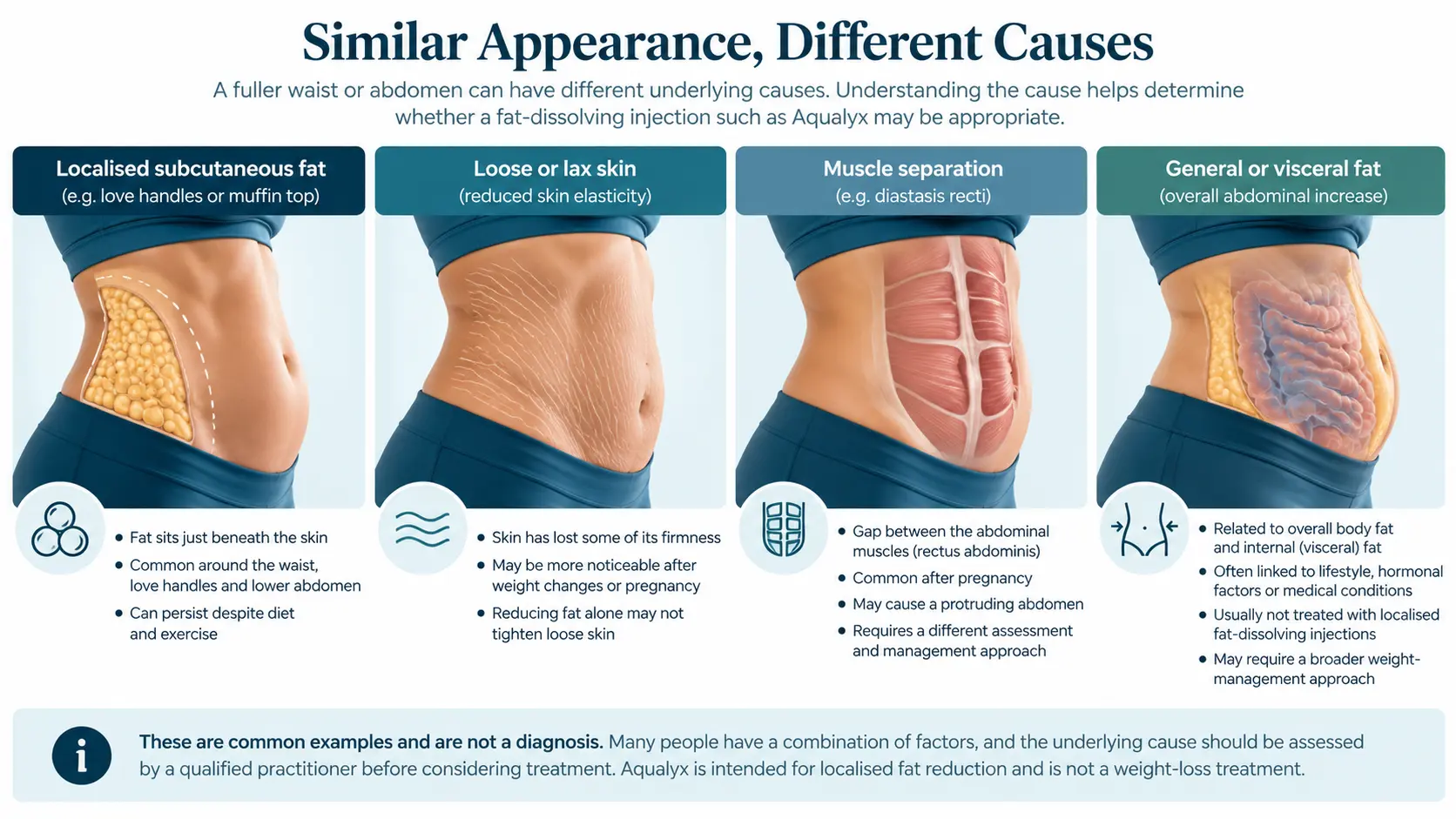
“Muffin top” and “love handles” are informal descriptions of fullness around the waist. A muffin top usually refers to tissue that sits over the waistband, while love handles commonly describe fullness at the sides of the waist. The appearance may extend towards the lower back.
These terms describe an appearance, not a diagnosis. The area may contain localised subcutaneous fat—the fat beneath the skin—but its shape can also be influenced by skin laxity, the distribution of body fat, muscle structure and previous weight changes.
Loose skin and excess fat are different concerns. If the skin has lost some of its elasticity, reducing the fat beneath it may not give the area the appearance you want. The first step is to establish what is causing the fullness and whether the proposed treatment is appropriate.
Can Aqualyx reduce a muffin top or stubborn belly fat?

A treatment intended for localised fat reduction may be discussed when a person has a defined pocket of subcutaneous fat. However, whether Aqualyx is appropriate for the waist or abdomen must be established from the exact product documentation and the evidence relevant to that use.
Evidence from studies of other injectable deoxycholic-acid products, particularly studies involving fat beneath the chin, cannot simply be transferred to Aqualyx or to every body area. The product, formulation, treatment site and protocol all matter. Check out our before-and-after results for the various options available at LipoSculpt Sutton.
It is also important to distinguish localised fullness from a larger abdomen. Abdominal size can reflect several factors, including overall body fat, bloating, posture, muscle separation or a medical condition. An injectable cosmetic treatment should not be used as a substitute for appropriate assessment where the cause is unclear.
A realistic consultation should answer three questions:
- Is the concern actually caused by a localised pocket of fat?
- Is the exact product proposed suitable for that area under its current instructions and applicable requirements?
- Is the likely outcome consistent with what the person wants to achieve?
If any of these questions remains unanswered, treatment should not be assumed to be appropriate.
Which treatment areas may be considered?
People researching fat-dissolving treatments commonly ask about the abdomen, waist, flanks, thighs, upper arms, back and area beneath the chin. These are areas of interest, not a list of confirmed or universally suitable Aqualyx treatment sites.
Suitability depends on the exact product and its permitted or intended use, the evidence for the proposed area, the anatomy involved and an individual assessment. A claim that a treatment is used in one area does not prove that it is suitable for another.
| Area of concern | What needs to be assessed |
|---|---|
| Waist and love handles | Whether the fullness is a defined pocket of subcutaneous fat, the skin quality and the realistic scope for contour change |
| Abdomen | Whether the prominence is caused by localised fat or other factors that need a different approach |
| Lower back | The amount and distribution of tissue, skin laxity and whether the proposed treatment is supported for that site |
| Thighs or upper arms | The characteristics of the tissue, the proposed product’s instructions and the evidence for that area |
| Under the chin | The anatomy of the area, relevant structures and the evidence for the specific product being considered |
This table is a guide to the questions an assessment should address. It is not confirmation that Aqualyx is authorised, indicated or appropriate for every area listed.
Who might be suitable for treatment?
A person exploring localised fat reduction should first have an assessment with an appropriately qualified practitioner who is trained and insured for the proposed procedure.
The assessment should consider:
- The location, amount and characteristics of the tissue.
- Skin elasticity and whether loose skin is a substantial part of the concern.
- Medical history, current medicines and relevant allergies.
- Previous procedures or treatment in the area.
- Any skin infection, inflammation or other problem affecting the proposed site.
- The exact product, its current instructions and evidence for the proposed use.
- The person’s expectations and whether a different option may be more appropriate.
Body weight and clothing size alone cannot determine suitability. The practitioner needs to assess the area being treated, whether the proposed procedure is likely to help and whether its potential benefits outweigh the risks for that individual.
A person hoping to lose a large amount of weight, remove substantial excess tissue or achieve a dramatic change in body shape may need to consider different options. Significant skin laxity may also limit how much improvement a fat-reduction procedure can provide. Check our other body sculpting options Sutton if you don’t find it suitable.
When might Aqualyx not be appropriate?
Treatment may be unsuitable, postponed or require further medical advice depending on the person’s health, the proposed area and the product’s current instructions.
Pregnancy or breastfeeding, active infection or inflammation at the proposed site, relevant allergies, certain medical conditions and medicines that may affect bleeding or healing are examples of issues that need to be discussed. This is not a complete contraindication list. The exact product documentation and an individual medical assessment should determine the relevant precautions.
Tell the practitioner about previous procedures, medicines, supplements, allergies and any health condition that may affect treatment or recovery. Do not stop prescribed medication unless the clinician responsible for your care advises you to do so.
A responsible practitioner should be willing to postpone treatment, recommend further assessment or explain why another option is more suitable. A request for cosmetic treatment does not mean that treatment must go ahead.
What happens during an Aqualyx consultation and treatment?
The consultation should come before any decision to proceed. It should establish the concern, assess the proposed area, review relevant medical history and explain the expected benefits, limitations, risks and alternatives.
The practitioner should identify the exact product that would be used and explain the evidence and instructions relevant to the proposed treatment. If the product’s intended use, documentation or suitability cannot be established, that uncertainty should be resolved before treatment.
If treatment is considered appropriate, the practitioner should explain the procedure and provide time for questions and an informed decision. The method of administration, amount used, number of injections and number of sessions must depend on the verified product instructions and individual treatment plan. There is no reliable universal formula that applies to every person and every area.
Ask who will perform the procedure, what training and insurance they have, how complications are managed and who will provide aftercare. You should not feel pressured to book immediately.
What results can you expect, and how long do they take?
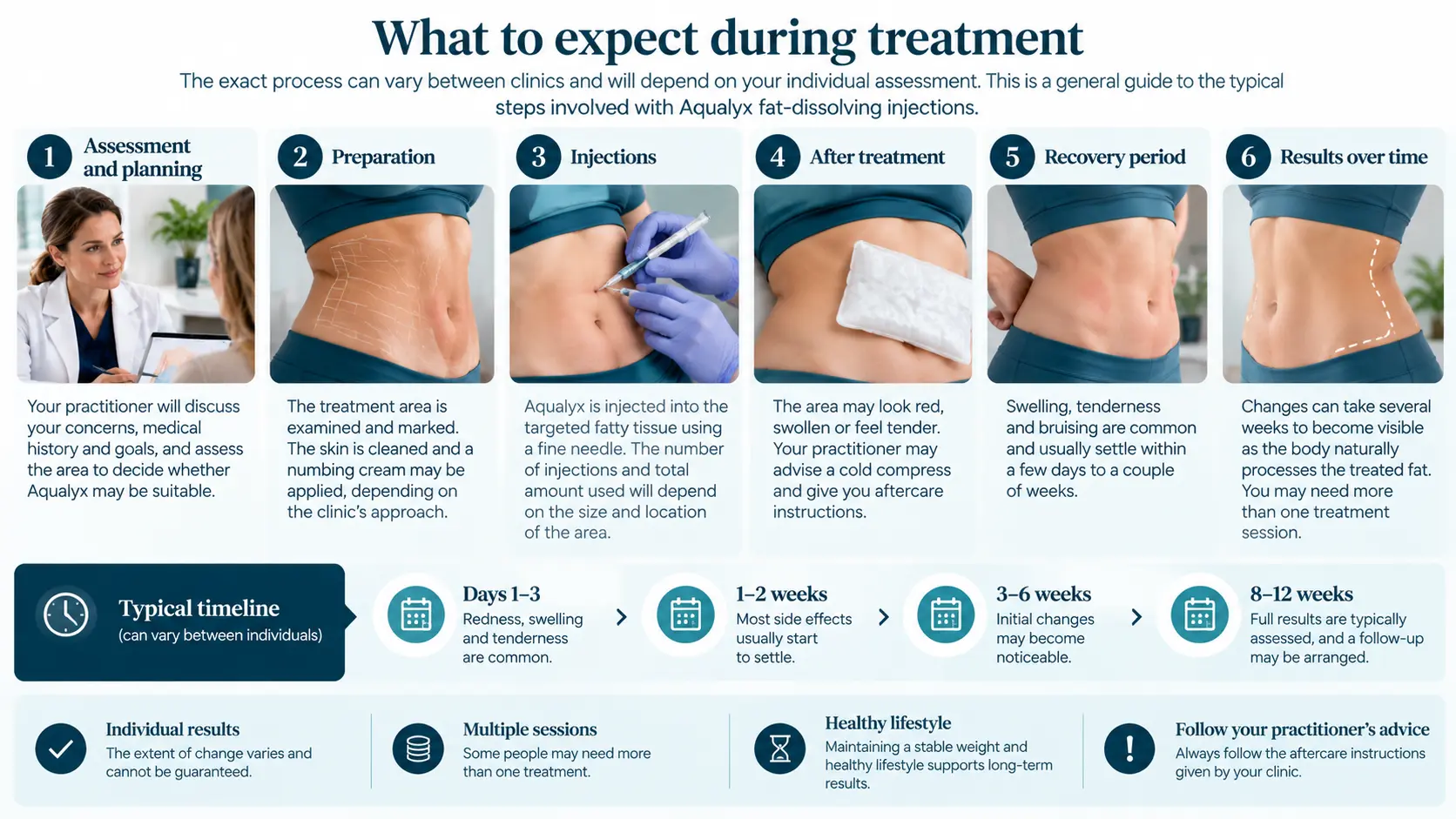
No responsible assessment can guarantee a particular change in waist size, abdominal appearance or clothing fit. Results depend on the product, the area treated, individual anatomy, the treatment plan and the quality of evidence supporting that use.
Swelling and tenderness after injections can temporarily change how the treated area looks. Ask the practitioner how long these reactions may last, when the result can be assessed and whether you will need a follow-up appointment.
Some injectable fat-reduction treatments are administered over more than one session. However, a fixed number of sessions should not be promised without considering the product instructions, the area and the individual’s response.
Before agreeing to treatment, ask the practitioner to explain:
- What change is realistically possible in your case.
- What evidence supports the proposed product and treatment area.
- When the result can be assessed fairly.
- Whether additional sessions might be considered and why.
- What would happen if the result is limited or uneven.
A claim based on a different product or treatment area is not a guarantee of your outcome. Before-and-after photographs should be genuine, relevant to the treatment being discussed and presented without misleading editing or staging. Check our ToneSculpt Program from LipoSculpt Sutton.
What are the risks and side effects?
Fat-dissolving injections are not risk-free. Reactions vary according to the product, the treatment area, the technique used and individual circumstances.
Possible local reactions reported with injectable fat-reduction procedures include:
- Pain, tenderness or a burning sensation.
- Swelling, redness and bruising.
- Temporary numbness or altered sensation.
- Firmness, lumps or nodules in the treated area.
- Uneven contour or an appearance that differs from what was expected.
More serious complications have also been reported with injectable fat-reduction products, including infection, persistent inflammation, tissue injury and contour irregularities. The specific risks for Aqualyx must be established from reliable product-specific information rather than assumed from studies of another injectable.
Correct product identification, suitable patient selection, knowledge of anatomy, appropriate technique and a clear plan for managing complications are important safety considerations. They do not remove all risk.
Seek prompt medical advice if you develop severe or worsening pain, spreading redness, marked skin colour changes, blistering, discharge, fever or another unexpected reaction after treatment. If symptoms are severe or you feel acutely unwell, seek urgent medical care rather than waiting for a routine follow-up.
Can fat-dissolving injections cause sagging skin?
Reducing localised fat does not guarantee tighter skin. The appearance afterwards can depend on existing skin elasticity, the amount of tissue involved, previous weight changes and other individual factors.
Where skin laxity is already significant, reducing the underlying fullness may leave loose skin visible. Equally, it would be misleading to claim that injections inevitably cause sagging in everyone.
The available evidence needs careful interpretation. Studies of deoxycholic-acid products for fat beneath the chin do not establish the same outcome for every product or body area. Product-specific evidence is needed before making a claim about skin tightening or the likelihood of sagging.
If loose skin is the main concern, ask for an assessment of skin quality and discuss the limitations of fat reduction before proceeding.
For a fuller discussion, see our separate guide: Can Fat-Dissolving Injections Cause Sagging Skin?
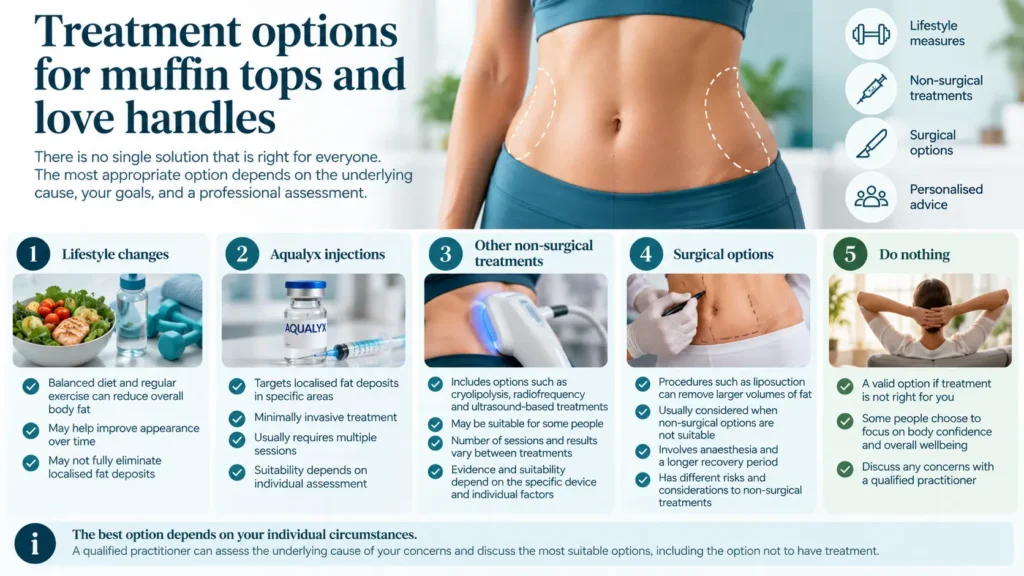
How does Aqualyx compare with other options?
Aqualyx is not interchangeable with other body-contouring treatments. The options differ in their mechanisms, evidence, recovery, risks and the amount of change they may offer.
| Option | Main distinction | What to consider |
|---|---|---|
| Fat-dissolving injections | Injectable products intended to address selected areas of localised fat | Product-specific evidence, intended use, risks and suitability for the proposed area must be confirmed |
| Cryolipolysis (fat freezing) | Uses controlled cooling to target localised fat without injections | Suitability, possible adverse effects and the likely degree of change depend on the device and individual |
| Liposuction | A surgical procedure that removes fat directly | Involves surgery, recovery and surgical risks; may be considered when a larger change is sought |
| Skin-removal or skin-tightening options | Focus on excess skin or skin appearance rather than simply reducing fat | The right approach depends on the degree of laxity, the procedure and the individual’s circumstances |
| Weight-management support | Addresses overall weight and health rather than one isolated pocket of fat | May involve lifestyle support or medical assessment, depending on individual needs |
Each option has different benefits, limitations and risks. The right choice depends on the cause of the concern, your health and the result you hope to achieve. After discussing the alternatives, you may decide that a different treatment—or no procedure at all—is the better choice.
What should you ask before agreeing to treatment?
![Consultation Matters_ Aqualyx Assessment Guide from liposculpt {name]](/wp-content/uploads/2026/10/Consultation-Matters_-Aqualyx-Assessment-Guide-from-liposculpt-name.webp "Aqualyx Fat-Dissolving Injections: Treatment Areas, Suitability, Results & Risks 6")
Use the consultation to get clear answers rather than relying on broad promises or social-media claims.
- What exact product will be used, and can I see its current product information?
- What evidence supports its use for my particular treatment area?
- What are the relevant UK regulatory requirements for this product and proposed use?
- What makes me a suitable candidate, and what factors could make treatment inappropriate?
- What result is realistic, and when should it be assessed?
- What side effects and serious complications should I understand?
- Who will perform the procedure, and what training and insurance do they have?
- What aftercare and follow-up will be provided?
- Who should I contact if I experience a complication?
- What alternatives are available, including doing nothing?
The NHS advises people considering cosmetic procedures to check a practitioner’s training and experience, understand the risks and aftercare, and take time to decide. A consultation should give you the information needed to make a considered choice, not pressure you into booking.
Frequently asked questions
Is Aqualyx a weight-loss treatment?
No. It is associated with localised fat-reduction and body-contouring treatments, not general weight loss or treatment for obesity. The exact product and its proposed use should be verified before treatment.
Can Aqualyx be used on the stomach?
Do not assume that a product is suitable for the abdomen simply because it is used or advertised for another area. The proposed abdominal use must be checked against the exact product instructions, applicable requirements and relevant evidence.
How soon will I see results?
The timing and extent of any visible change can vary. Early swelling and tenderness can affect the appearance of the area, so the practitioner should explain when a meaningful assessment can be made.
Can fat-dissolving injections cause loose skin?
Reducing fat does not necessarily tighten loose skin. If the skin already lacks elasticity, reducing the underlying fat may leave it looking loose. Have the area assessed beforehand and ask what change the proposed treatment could realistically achieve.
Is Aqualyx the same as liposuction?
No. Liposuction is surgery that removes fat directly. Aqualyx is associated with an injectable approach to localised fat reduction. The treatments differ in technique, recovery, risks and potential outcomes and should not be presented as equivalent.
Can Aqualyx get rid of muffin tops?
A defined pocket of fat around the waist may prompt someone to explore localised fat-reduction options. Whether Aqualyx is appropriate for that area depends on the exact product, the supporting evidence, skin quality and individual assessment. A particular result cannot be guaranteed.
How many Aqualyx sessions will I need?
There is no universal number that applies to everyone. Any proposed treatment schedule should be based on verified product instructions, the treatment area, individual assessment and response. Be cautious of guarantees made before an assessment.
Is Aqualyx painful?
Injection procedures can cause discomfort, and local reactions such as tenderness, swelling or bruising may occur. The likely experience depends on the product, area and individual. Ask the practitioner what to expect and how discomfort will be managed.
Are fat-dissolving injections risk-free?
No. Temporary local reactions can occur, and more serious complications have been reported with injectable fat-reduction procedures. Product-specific risks, suitability, technique and aftercare should be discussed before a decision is made.
How do I choose a practitioner?
Ask about relevant qualifications, training, experience, insurance, the exact product being used, evidence for the proposed area, aftercare and the plan for managing complications. The NHS recommends a consultation with the person who will perform the procedure and time to consider the decision.
References and further reading
The sources listed here include research on fat-dissolving injections, information from product manufacturers and guidance on cosmetic treatment safety. Not all of the research concerns Aqualyx itself. Where a study looks at a different product or a different area of the body, its findings may not apply to Aqualyx.
- Marllor Biomedical — Aqualyx Cosmetic. Manufacturer information. Check the current page and product documentation carefully; the current public page contains a topical-application statement that must be reconciled with any proposed injectable use.
https://www.marllor.com/aqualyx - U.S. Food and Drug Administration — Using Fat-Dissolving Injections That Are Not FDA Approved Can Be Harmful. US-specific safety and regulatory information; it does not determine UK regulatory status.
https://www.fda.gov/drugs/buying-using-medicine-safely/using-fat-dissolving-injections-are-not-fda-approved-can-be-harmful - Liu C, Li MK, Alster TS. Alternative Cosmetic and Medical Applications of Injectable Deoxycholic Acid: A Systematic Review. Dermatologic Surgery. 2021;47(11):1466–1472. The review notes that evidence for uses beyond the submental area is limited and that stronger studies are needed.
https://pubmed.ncbi.nlm.nih.gov/34537786/ - A Systematic Review of Injectable Lipolytic Agents for Nonsubmental Fat Reduction. Plastic and Reconstructive Surgery. 2025. Reviews different injectable agents and highlights the need for further trials and standardised protocols. Findings across multiple agents should not be attributed specifically to Aqualyx.
https://pubmed.ncbi.nlm.nih.gov/41296813/ - Cunha KS, Lima F, Cardoso RM. Efficacy and safety of injectable deoxycholic acid for submental fat reduction: a systematic review and meta-analysis of randomized controlled trials. Expert Review of Clinical Pharmacology. 2021. Evidence concerns submental fat and deoxycholic acid, not every product or body area.
https://pubmed.ncbi.nlm.nih.gov/33523775/ - NHS — Choosing who will do your cosmetic procedure. Guidance on practitioner training, consultation, risks, aftercare and what to ask before proceeding.
https://www.nhs.uk/tests-and-treatments/cosmetic-procedures/advice/choosing-who-will-do-your-procedure/ - NHS — Before you have a cosmetic procedure. Guidance on researching a procedure, understanding costs and risks, choosing a practitioner and taking time to decide.
https://www.nhs.uk/tests-and-treatments/cosmetic-procedures/advice/before-you-have-a-cosmetic-procedure/ - Advertising Standards Authority / Committee of Advertising Practice — Cosmetic interventions: non-surgical procedures. Guidance on responsible advertising, evidence for efficacy claims and avoiding misleading or exaggerated representations.
https://www.asa.org.uk/advice-online/cosmetic-interventions-non-surgical-procedures.html - Medicines and Healthcare products Regulatory Agency — Register medical devices to place on the market. UK guidance on medical-device registration and the distinction between registration and MHRA endorsement.
https://www.gov.uk/guidance/register-medical-devices-to-place-on-the-market
Medical information notice: This article is for general information and is not a diagnosis or a substitute for an individual consultation. The product, its instructions, its regulatory status and its suitability for any proposed treatment area must be verified before treatment. Clinical and regulatory questions should be reviewed by a suitably qualified professional before publication.